Jamás he estado en las Pribilof, esas islas del Mar de Bering hacia las que ponían proa en la maravillosa película El Mundo en sus Manos de Raoul Walsh. De momento me he quedado en la Alaska continental. Pero esa frase exclamada al frío viento del océano en el celuloide de 1952 siempre me ha sugerido las aventuras y emociones que, de alguna manera, intento encontrar en mis viajes.
Mostrando entradas con la etiqueta India. Mostrar todas las entradas

jueves, 31 de marzo de 2011

OTRA PROSA DESDE EL OBSERVATORIO (NUEVA DELHI, INDIA)


Las estrellas son las mismas en todas partes pero en todos los lugares son diferentes. Depende de quién las mire. De cómo las mire. Según el observador y el observatorio. Y no todos los observatorios son iguales.

Las estrellas sobre la India son diferentes. Hablan de millones de dioses y de voces que se pierden en la noche monzónica, de arqueros alados, de rostros azules. En Delhi hay un observatorio donde buscar esas estrellas y esos dioses, donde escuchar esas voces.

El Jantar Mantar es uno de los cinco observatorios astronómicos construidos en la India por el Maharajá Jai Singh en 1728 pero a mí, desde el primer momento, con sus formas geométricas y sus paredes rojas,  me pareció un parque de columpios y toboganes, un campo de juegos en el que pasar horas y horas bajo la calima húmeda y bochornosa de agosto esperando a que la brisa de la tarde traiga un poco de alivio de regreso de las tierras ocres y puras de Ladakh.

Por supuesto, mi otra prosa apenas rinde homenaje a la del siempre enorme y admirado Julio Cortázar.


(Nueva Delhi, agosto de 2006)


******** 

OTHER PROSE FROM THE OBSERVATORY  (NEW DELHI, INDIA)

Stars are the same everywhere but everywhere are different. It depends on who look at them. On how are they looked. According to the observer and the observatory. And not all the observatories are equal.

The stars over India are different. They speak about millions of gods and voices that are lost in the monsoon night, about winged archers, about blue faces. In Delhi there is an observatory to look for those stars and those gods, where to hear those voices.

The Jantar Mantar is one of the five astronomic observatories built in India by Maharaja Jai Singh in 1728 but, from the outset, with its geometric shapes and its red walls, it looked to me like a park with swings and slides, a playground to spend hours and hours in the humid and muggy August's haze waiting for the evening breeze to bring some relief coming back from Ladakh's ocher and pure lands.

Of course, my other prose barely pays tribute to the enormous and always admired Julio Cortazar's.

(New Delhi, August 2006)

(c) Copyright del texto y de las fotos: Joaquín Moncó

martes, 8 de febrero de 2011

COSTUMBRES (LADAKH, INDIA)

En el estado de Kashmir & Jammu, donde el rombo del subcontinente se cierra con un nudo, los rincones se estrangulan y las fronteras desaparecen, la India comprime su talla de gigante en un mínimo espacio de montañas y desiertos entre las costuras del Tibet y de Pakistán. 

A un lado, el límite difuso de línea discontinua juega al escondite con los lectores de atlas y mapas para  nunca estar donde se espera y acabar siempre en un lugar diferente. Los afilados acentos del Karakorum atraviesan el tamiz de Cachemira sin apenas advertir el cambio de lengua, raza o religión. Al otro extremo, el Tibet se derrama por encima de las vallas e invade las tierras ocres de Zanskar y Ladakh sin encontrar apenas resistencia. En ese cruce de caminos, la India deja de serlo y no puede evitar vivir permanentemente en casa del vecino.

Y en Ladakh, entre chortens, gompas y cumbres, perduran costumbres curiosas que sorprenden al visitante desprevenido. 

Los gigantes ponen los dedos de sus pies a secar al sol después de cada aguacero.


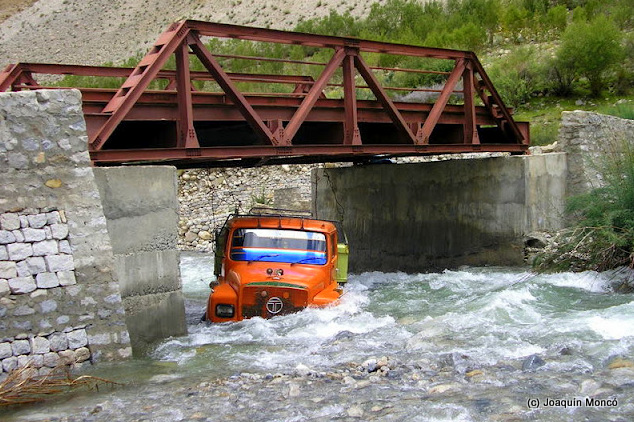
Los camiones se sueñan barcas y circulan bajo los puentes.


Las piedras abren agujeros para tragarse a los lobos.


La colada se tiende en las cumbres de las  montañas.


(Ladakh, agosto de 2006)


********

CUSTOMS  (LADAKH, INDIA)

In the state of Jammu & Kashmir, where the subcontinent's diamond is closed with a knot, the corners are stragulated and borders disappear, India compresses its giant size in a tiny space of mountains and deserts between the seams of Tibet and Pakistan.

On a hand, the vague boundary of broken line plays hide and seek with the atlases and maps readers to never be where expected and always ends in a different place. Karakorum's sharp accents cross the sieve of Kashmir hardly noticing the change of language, race or religion. At the other hand, Tibet spills over fences and invades Zanskar and Ladakh's ocher lands finding little resistance. At this crossroads, India ceases to exist and can not help but living permanently in a neighbour's house.

In Ladakh, among chortens, gompas and peaks, remain odd customs that surprise the unaware visitor.

Giants lay their toes in the sun to be dried after each shower.
Trucks think they are boats and travel under the bridges.
Stones open holes to swallow up the wolves. 
The laundry is hung on the tops of the mountains.

(Ladakh, August 2006)

(c) Copyright del texto y de las fotos: Joaquín Moncó

jueves, 19 de agosto de 2010

CHORTEN (LADAKH, INDIA)


Los chorten habitan a sus anchas en los terrosos caminos de Ladakh. Como centinelas de adobe vigilan mi  paso a la salida y entradas de los pueblos, con su aire sereno. Los hay modernos, recién blanqueados, con la llama dorada refulgiendo al sol, pero también muchos, la mayoría, decrépitos a  punto de derrumbarse, soportando el paso del tiempo de mala manera y mimetizándose con los montones de tierra.

Originalmente contenían las reliquias o restos de algún santón local, pero actualmente muchos de ellos se elevan como monumento de oración y plegaria budista sin que oculten hueso alguno en su interior. Podemos encontrarlos por todo el arco tibetano, con diferentes formas, tamaños o nombres, pero stupas similares a fin de cuentas.

Dicen que representan los cinco elementos purificados de la naturaleza y que cada parte en su estructura refleja cada una de estas potencias: la base cuadrada representa la tierra, la cúpula representa el agua, el cono representa el fuego, el loto y la luna creciente en la parte superior representa el aire y, por último, el sol que corona el conjunto representa el ether.

(Ladakh, agosto de 2006)


********


CHORTEN (LADAKH, INDIA)


Chortens live at ease in the dirt roads of Ladakh. As dried mud sentinels, they watch my way at the exit and entrances to villages in a serene air. Some are modern, newly whitewashed, with the golden flame glowing in the sun, but many, most of them, are decrepit about to collapse, enduring hardly over time, blending into the earth mounds.

Originally contained the relics or remains of a local holy man, but now many of them are raised as a  Buddhist monument for prayer without a bone hidden within. They can be found along the whole Tibetan arch in different shapes, sizes and names, but similar stupas in the end.

It's told that they symbolize the five purified elements of nature and that each part in their structure reflects each of these powers: the square base symbolizes earth, the dome symbolizes water, the cone symbolizes fire, the lotus and the waxing moon at the top symbolize air and, finally, the sun crowning the whole symbolizes ether.

(Ladakh, August 2006)


(c) Copyright del texto y de las fotos: Joaquín Moncó

viernes, 23 de julio de 2010

ESPECTROS: STOK KANGRI 6137m (LADAKH, INDIA)


Arista en el Stok Kangri

Al llegar a la arista el sol me alcanzó e iluminó de pleno la cascada de nubes que cruzaba a toda prisa sobre el collado allá abajo y toda la cadena de los Kangri. Con el sol se levantó el viento que empujó el impetuoso río blanco de vapor contra el filo quebrado deshilachándose en guedejas fantasmales. El mundo a mis pies se iluminó de improviso revelando un horizonte inmenso de picos y valles ocres hasta donde alcanzaba la vista. En el borde del cielo las cimas brillantes de las cordilleras lejanas se confundían con los rebaños de nubes que trazaban la línea difusa entre tierra y azul. Por alguno de esos destellos, al noroeste, rondaba el K2 y demás cimas del Karakorum a vuelo de pájaro sobre Cachemira, más allá de Zanskar.

Cresta cimera. Útimos pasos

Como otras veces me ha sucedido, la salida del astro ejerció algún tipo de bálsamo sobre mi cuerpo que suele mostrarse perezoso y revuelto a la luz de los frontales caminando entre las sombras, pero que, con los primeros rayos, tiende a encontrar el equilibrio perdido en las horas lunares. Ya quedaba menos para la cima, tan sólo recorrer la cresta nevada hasta el cúmulo de banderas de oración tibetanas que marcaba el final del camino vertical mientras esparcían al viento miles de Om Mane Padme Um. Parecía al alcance de la mano. Con un vistazo al altímetro pude comprobar que ya estaba por encima de los 6000 metros de altitud. A pesar de la cota no notaba excesivo frío, el bajo cero de rigor. Ahora sólo andar con cuidado y ya está.

El horizonte se abre hacia el Karakorum al noroeste

Ese verano el monzón había superado la gran barrera del Himalaya y las lluvias habían llegado de improviso a Ladakh provocando que el Indo se desbordara y se inundara el valle del Markha. También había conseguido que el Stok Kangri ese año estuviera cubierto con más nieve de lo habitual en esas fechas y que luciera tapizado de blanco desde los pies a la cabeza. Una ascensión más agradecida de lo esperado. La arista se mostraba fácil pero había que remontarla con cuidado, que no se puede tropezar en esas lides. Algún flanqueo sobre la vertiente contraria que se despeñaba a pico, un rodeo a unas rocas, una nieve no muy consistente..., no se podía bajar la guardia. Pero lo que más dificultaba el ascenso era precisamente la altitud, esa barrera invisible que me obligaba a detenerme cada treinta pasos cuando mentalmente me hacía el propósito de no parar hasta la misma cumbre, esa telaraña inasible que, a pesar de encontrarme en plena forma y correctamente aclimatado, me abrazaba y me decía que me tomara las cosas con calma y que disfrutara del momento.

Stok Kangri entre las nubes

Y en esas estaba cuando, a mi izquierda, sobre el extenso mar de nubes que se iba formando en los valles bajos como un descomunal lienzo, el sol naciente quiso dibujar para mí el espectáculo extraño e insólito que raras veces se otorga. El mismo que Whymper vio sobre la arista del Cervino con ocasión de su gesta. El espectro de Brocken. Irreal, mágico, de otro mundo. Mi propia imagen distorsionada hasta extremos inconcebibles dentro de un halo irisado que parecía remedar cada uno de mis movimientos como en una burla siniestra. De algún modo hermoso. Dos espectros en la misma montaña.

Tan absorto me quedé que ni se me ocurrió inmortalizar el momento con mi cámara compacta que a duras penas respondía al frío. Superado el instante fugaz, continué mis pasos hasta alcanzar la cima del Stok Kangri.

(Ladakh, agosto de 2006)

Cumbre del Stok Kangri (6137m)


********

GHOSTS:  STOK KANGRI (LADAKH, INDIA)

Reaching the ridge the sun hit me full and illuminated the waterfall of clouds that hurried across the col down there and the whole chain of Kangri. With the sun rose the wind that pushed the white and rushing river of vapours against the broken edge fraying it in ghostly locks. The world at my feet suddenly lit up revealing a vast horizon of peaks and brown valleys as far as the eye could see. At the edge of the sky the bright summits of distant ridges mingled with the herds of clouds that traced the blurred line between earth and blue. On one of those flashes in the northwest rised K2 and other peaks of the Karakorum as the crow flies over Kashmir, beyond Zanskar.

As other times, the sunrise acted like some kind of balm on my body which usually appears lazy and upset to the headlamp light while walking in the shadows, but, with the first rays, tends to find the lost balance in lunar hours. It was less for the top, just go through the snowy ridge to the cluster of Tibetan prayer flags marking the end of the vertical path while thousands of Om Mane Padme Um were scattered in the wind. It seemed close at hand. With a look at the altimeter, I saw that I was above 6000 meters high. Despite the altitude I did not feel too much cold, the usual freezing. Now just be careful and done.

That summer, the monsoon had passed the great barrier of the Himalayas and rains had come unexpectedly to Ladakh causing Indus overflow and flooding the valley of Markha. It also caused that the Stok Kangri was covered that year with more snow than usual a this time and that it shone carpeted in white from head to toe. An easier ascent than expected. The ridge looked smooth but I had to soar it up carefully, not stumbling by no means. Some flanking on the opposite slope that plunged down, a detour to some rocks, not very solid snow ... I could not lower my guard. But the climb was hindered the most by the altitude, that invisible barrier that forced me to stop every thirty paces when mentally I had intended not to stop until the very top; that elusive cobweb that, despite being in great shape and properly acclimated, hugged me and told me to take it easy and enjoy the moment.


And suddenly, to my left, over the vast sea of clouds that gathered in the lower valleys as a colossal canvas, the rising sun drawed for me a weird and unusual spectacle rarely granted. The same that Whymper saw on the Matterhorn's ridge when his achievement. The Brocken Spectre. Unreal, magical, otherworldly. My own shadow inconceivably distorted inside an iridiscent halo that seemed to mimic my movements as a sinister joke. Somehow beautiful. Two ghosts on the same mountain.

I was so absorbed that not even captured the moment with my compact camera that hardly worked in the cold. The fleeting moment past, I followed my steps to reach the Stok Kangri summit.

(Ladakh, August 2006)


(c) Copyright del texto y de las fotos: Joaquín Moncó

miércoles, 14 de julio de 2010

SUEÑO EN BLANCO: TAJ MAHAL (AGRA, INDIA)


Por mucho que había leído y me habían advertido, nunca pude sospechar que el sueño de Shah Jahan podía ser tan bello.

Ninguna imagen hace justicia a la tumba blanca de Agra. Dicen que el mejor momento para contemplarlo es al amanecer cuando las brumas matinales aún pugnan por levantarse y el edificio pareciera que flota ingrávido y etéreo sobre el vapor. Cuando yo llegué allí un día caluroso y húmedo de agosto de 2006, después de un largo viaje en autobús desde Delhi, no volaba sobre los estanques, sino que se posaba firmemente sobre sus basamentos, pero eso no le restaba ni una pizca de hermosura. Quizás un poco más pequeño de lo imaginado, con menos turistas occidentales y muchos locales, con algún andamio enroscado a los minaretes. Pero deslumbrante.


La tumba imposible que el penúltimo de los emperadores mogoles construyera para acoger a su llorada Mumtaz Mahal, el dolor más intenso que conoció jamás en los turbulentos años del siglo XVII, me desmoronó por completo. Emocionalmente profundo. Coup de foudre.

Cabe soñar qué espectáculo arquitectónico nos encontraríamos en la ribera del Yamuna si, como cuenta la tradición, se hubiera construido de manera simétrica al otro lado del río un mausoleo idéntico en mármol negro que alojara el cuerpo del Gran Mogol. Pero la malicia albergaba en el corazón de Aurangzeb, el hijo de Shah Jahan y último emperador de la dinastía, que no sólo encarceló a su padre en las estancias del fuerte rojo de Agra, desde donde podía contemplar la perla blanca de su amada, sino que nunca izó semejante cenotafio al cielo. Ahora, la tumba del rey, junto a la de Mumtaz Mahal, rompe la simetría perfecta del edificio blanco.


Entre cúpulas, frontones, minaretes, balcones, jardines, fuentes, estanques, la vista se pierde en un laberinto de líneas puras y rosas blancas que elevan el Taj Mahal sobre las llanuras del Yamuna como un diamante eterno y perfecto. Un sueño que me encanta soñar.

(Agra, agosto de 2006)


********


WHITE DREAM: TAJ MAHAL   (AGRA, INDIA)

No matter how much I had read and had been warned, I never suspected that Shah Jahan's dream could be so beautiful.


No image does justice to the white tomb in Agra. I was told that the best time to watch it is at sunrise when the morning mists still struggle to get up and the building seems to float weightless and ethereal on the steam. When I arrived there a hot, humid day in August 2006 after a long bus ride from Delhi, it did not fly over the ponds, but rested firmly on its foundations, however that did not detract one iota of its beauty. Maybe a little smaller than imagined, with fewer Western tourists and many locals, with some scaffolding coild up the minarets. But dazzling.


The impossible tomb that the penultimate of the Mughal emperors built to accommodate his mourned Mumtaz Mahal, the more intense sorrow ever suffered in the turbulent years of the seventeenth century, collapsed me absolutely. Emotionally deep. Coup de foudre.


We can imagine which architectural spectacle could be found on the banks of Yamuna if, as tradition tells, had been built symmetrically across the river an identical black marble mausoleum to host the body of the Great Mogul. But the malice harbored in the heart of Aurangzeb, Shah Jahan's son and last emperor of the dynasty, that not only imprisoned his father in the rooms of the Red Fort of Agra, from where he could see the pearl white of his beloved, but he never raised to the sky such a cenotaph. Now the king's tomb, next to Mumtaz Mahal's, breaks the perfect symmetry of the white building.


Among domes, pediments, minarets, balconies, gardens, fountains, ponds, sight is lost in a labyrinth of pures lines and white roses that raise the Taj Mahal on the plains of Yamuna as an eternal and perfect diamond. A dream that I love to dream.


(Agra, August 2006)


(c) Copyright del texto y de mis fotos: Joaquín Moncó